Showing posts with label Nasa Hubble Space Telescope. Show all posts

NASA's Hubble Space Telescope Finds Dead Stars 'Polluted with Planet Debris


NASA's Hubble Space Telescope has found the building blocks for Earth-sized planets in an unlikely place-- the atmospheres of a pair of burned-out stars called white dwarfs.

These dead stars are located 150 light-years from Earth in a relatively young star cluster, Hyades, in the constellation Taurus. The star cluster is only 625 million years old. The white dwarfs are being polluted by asteroid-like debris falling onto them.
NASA's Hubble Space Telescope Finds Dead Stars 'Polluted with Planet Debris


Hubble's Cosmic Origins Spectrograph observed silicon and only low levels of carbon in the white dwarfs' atmospheres. Silicon is a major ingredient of the rocky material that constitutes Earth and other solid planets in our solar system. Carbon, which helps determine properties and origin of planetary debris, generally is depleted or absent in rocky, Earth-like material.

"We have identified chemical evidence for the building blocks of rocky planets," said Jay Farihi of the University of Cambridge in England. He is lead author of a new study appearing in the Monthly Notices of the Royal Astronomical Society. "When these stars were born, they built planets, and there's a good chance they currently retain some of them. The material we are seeing is evidence of this. The debris is at least as rocky as the most primitive terrestrial bodies in our solar system."

This discovery suggests rocky planet assembly is common around stars, and it offers insight into what will happen in our own solar system when our sun burns out 5 billion years from now.

Farihi's research suggests asteroids less than 100 miles (160 kilometers)
wide probably were torn apart by the white dwarfs' strong gravitational forces. Asteroids are thought to consist of the same materials that form terrestrial planets, and seeing evidence of asteroids points to the possibility of Earth-sized planets in the same system.

The pulverized material may have been pulled into a ring around the stars and eventually funneled onto the dead stars. The silicon may have come from asteroids that were shredded by the white dwarfs' gravity when they veered too close to the dead stars.

Nasa News - Transforming Galaxies

Many of the Universe's galaxies are like our own, displaying beautiful spiral arms wrapping around a bright nucleus. Examples in this stunning image, taken with the Wide Field Camera 3 on the NASA/ESA Hubble Space Telescope, include the tilted galaxy at the bottom of the frame, shining behind a Milky Way star, and the small spiral at the top center.


Other galaxies are even odder in shape. Markarian 779, the galaxy at the top of this image, has a distorted appearance because it is likely the product of a recent galactic merger between two spirals. This collision destroyed the spiral arms of the galaxies and scattered much of their gas and dust, transforming them into a single peculiar galaxy with a unique shape.

This galaxy is part of the Markarian catalogue, a database of over 1500 galaxies named after B. E. Markarian, the Armenian astronomer who studied them in the 1960s. He surveyed the sky for bright objects with unusually strong emission in the ultraviolet.

Ultraviolet radiation can come from a range of sources, so the Markarian catalog is quite diverse. An excess of ultraviolet emissions can be the result of the nucleus of an "active" galaxy, powered by a supermassive black hole at its center. It can also be due to events of intense star formation, called starbursts, possibly triggered by galactic collisions. Markarian galaxies are, therefore, often the subject of studies aimed at understanding active galaxies, starburst activity, and galaxy interactions and mergers.

Herschel and Spitzer See Nearby Galaxies' Stardust

The cold dust that builds blazing stars is revealed in new images that combine observations from the Herschel Space Observatory, a European Space Agency-led mission with important NASA contributions; and NASA's Spitzer Space Telescope. The new images map the dust in the galaxies known as the Large and Small Magellanic Clouds, two of the closest neighbors to our own Milky Way galaxy.

The Large Magellanic Cloud looks like a fiery, circular explosion in the combined Herschel-Spitzer infrared data. Ribbons of dust ripple through the galaxy, with significant fields of star formation noticeable in the center, center-left and top right (the brightest center-left region is called 30 Doradus, or the Tarantula Nebula, for its appearance in visible light). The Small Magellanic Cloud has a much more irregular shape. A stream of dust extends to the left in this image, known as the galaxy's "wing," and a bar of star formation appears on the right.

The colors in these images indicate temperatures in the dust that permeate the Magellanic Clouds. Colder regions show where star formation is at its earliest stages or is shut off, while warm expanses point to new stars heating dust surrounding them. The coolest areas and objects appear in red, corresponding to infrared light taken up by Herschel's Spectral and Photometric Imaging Receiver at 250 microns, or millionths of a meter. Herschel's Photodetector Array Camera and Spectrometer fills out the mid-temperature bands, shown in green, at 100 and 160 microns. The warmest spots appear in blue, courtesy of 24- and 70-micron data from Spitzer.

"Studying these galaxies offers us the best opportunity to study star formation outside of the Milky Way," said Margaret Meixner, an astronomer at the Space Telescope Science Institute, Baltimore, Md., and principal investigator for the mapping project. "Star formation affects the evolution of galaxies, so we hope understanding the story of these stars will answer questions about galactic life cycles."

The Large and Small Magellanic Clouds are the two biggest satellite galaxies of our home galaxy, the Milky Way, though they are still considered dwarf galaxies compared to the big spiral of the Milky Way. Dwarf galaxies also contain fewer metals, or elements heavier than hydrogen and helium. Such an environment is thought to slow the growth of stars. Star formation in the universe peaked around 10 billion years ago, even though galaxies contained lesser abundances of metallic dust. Previously, astronomers only had a general sense of the rate of star formation in the Magellanic Clouds, but the new images enable them to study the process in more detail.

The results were presented today at the 219th meeting of the American Astronomical Society in Austin, Texas.

Herschel is a European Space Agency cornerstone mission, with science instruments provided by consortia of European institutes and with important participation by NASA. NASA's Herschel Project Office is based at NASA's Jet Propulsion Laboratory, Pasadena, Calif. JPL contributed mission-enabling technology for two of Herschel's three science instruments. The NASA Herschel Science Center, part of the Infrared Processing and Analysis Center at the California Institute of Technology in Pasadena, supports the United States' astronomical community.

JPL manages the Spitzer Space Telescope mission for NASA's Science Mission Directorate, Washington. Science operations are conducted at the Spitzer Science Center at Caltech. Caltech manages JPL for NASA.

NASA's Hubble Makes One Millionth Science Observation

NASA's Hubble Space Telescope crossed another milestone in its space odyssey of exploration and discovery. On Monday, July 4, the Earth-orbiting observatory logged its one millionth science observation during a search for water in an exoplanet's atmosphere 1,000 light-years away.

"For 21 years Hubble has been the premier space science observatory, astounding us with deeply beautiful imagery and enabling ground-breaking science across a wide spectrum of astronomical disciplines," said NASA Administrator Charles Bolden. He piloted the space shuttle mission that carried Hubble to orbit. "The fact that Hubble met this milestone while studying a faraway planet is a remarkable reminder of its strength and legacy."

Hubble's Millionth ObservationAlthough Hubble is best known for its stunning imagery of the cosmos, the millionth observation is a spectroscopic measurement, where light is divided into its component colors. These color patterns can reveal the chemical composition of cosmic sources.

Hubble's millionth exposure is of the planet HAT-P-7b, a gas giant planet larger than Jupiter orbiting a star hotter than our sun. HAT-P-7b, also known as Kepler 2b, has been studied by NASA's planet-hunting Kepler observatory after it was discovered by ground-based observations. Hubble now is being used to analyze the chemical composition of the planet’s atmosphere.

"We are looking for the spectral signature of water vapor. This is an extremely precise observation and it will take months of analysis before we have an answer," said Drake Deming of the University of Maryland and NASA's Goddard Space Flight Center in Greenbelt, Md. "Hubble demonstrated it is ideally suited for characterizing the atmospheres of exoplanets, and we are excited to see what this latest targeted world will reveal."

Hubble was launched April 24, 1990, aboard space shuttle's Discovery's STS-31 mission. Its discoveries revolutionized nearly all areas of astronomical research from planetary science to cosmology. The observatory has collected more than 50 terabytes of data to-date.

Hubble's odometer reading includes every observation of astronomical targets since its launch and observations used to calibrate its suite of instruments. Hubble made the millionth observation using its Wide Field Camera 3, a visible and infrared light imager with an on-board spectrometer. It was installed by astronauts during the Hubble Servicing Mission 4 in May 2009.

"The Hubble keeps amazing us with groundbreaking science," said Sen. Barbara A. Mikulski, the chairwoman of the Senate Commerce, Justice, Science and Related Agencies Appropriations Subcommittee that funds NASA. "I championed the mission to repair and renew Hubble not just to get one million science observations, but also to inspire millions of children across the planet to become our next generation of stargazers, scientists, astronauts and engineers."

Hubble is a project of international cooperation between NASA and the European Space Agency. Goddard manages the telescope. The Space Telescope Science Institute (STScI) conducts Hubble science operations. STScI is operated for NASA by the Association of Universities for Research in Astronomy Inc. in Washington.

NASA's Hubble Finds Rare 'Blue Straggler' Stars in Milky Way's Hub

NASA's Hubble Space Telescope has found a rare class of oddball stars called blue stragglers in the hub of our Milky Way, the first detected within our galaxy's bulge.

Blue stragglers are so named because they seemingly lag behind in the aging process, appearing younger than the population from which they formed. While they have been detected in many distant star clusters, and among nearby stars, they never have been seen inside the core of our galaxy.

It is not clear how blue stragglers form. A common theory is that they emerge from binary pairs. As the more massive star evolves and expands, the smaller star gains material from its companion. This stirs up hydrogen fuel and causes the growing star to undergo nuclear fusion at a faster rate. It burns hotter and bluer, like a massive young star.

Blue straggler stars in the Milky WayThe findings support the idea that the Milky Way's central bulge stopped making stars billions of years ago. It now is home to aging sun-like stars and cooler red dwarfs. Giant blue stars that once lived there have long since exploded as supernovae.

The results have been accepted for publication in an upcoming issue of The Astrophysical Journal. Lead author Will Clarkson of Indiana University in Bloomington, will discuss them today at the American Astronomical Society meeting in Boston.

"Although the Milky Way bulge is by far the closest galaxy bulge, several key aspects of its formation and subsequent evolution remain poorly understood," Clarkson said. "Many details of its star-formation history remain controversial. The extent of the blue straggler population detected provides two new constraints for models of the star-formation history of the bulge."

The discovery followed a seven-day survey in 2006 called the Sagittarius Window Eclipsing Extrasolar Planet Search (SWEEPS). Hubble peered at 180,000 stars in the crowded central bulge of our galaxy, 26,000 light-years away. The survey was intended to find hot Jupiter-class planets that orbit very close to their stars. In doing so, the SWEEPS team also uncovered 42 oddball blue stars with brightness and temperatures typical for stars much younger than ordinary bulge stars.

The observations clearly indicate that if there is a young star population in the bulge, it is very small. It was not detected in the SWEEPS program. Blue stragglers long have been suspected to be living in the bulge, but had not been observed because younger stars in the disk of our galaxy lie along the line-of-sight to the core, confusing and contaminating the view.

Astronomers used Hubble to distinguish the motion of the core population from foreground stars in the Milky Way. Bulge stars orbit the galactic center at a different speed than foreground stars. Plotting their motion required returning to the SWEEPS target region with Hubble two years after the first observations were made. The blue stragglers were identified as moving along with the other stars in the bulge.

"The size of the field of view on the sky is roughly that of the thickness of a human fingernail held at arm's length, and within this region, Hubble sees about a quarter million stars toward the bulge," Clarkson said. "Only the superb image quality and stability of Hubble allowed us to make this measurement in such a crowded field."

From the 42 candidate blue stragglers, the investigators estimate 18 to 37 are likely genuine. The remainder could be a mix of foreground objects and, at most, a small population of genuinely young bulge stars.

"The SWEEPS program was designed to detect transiting planets through small light variations" said Kailash Sahu, the principal investigator of the SWEEPS program. "Therefore the program could easily detect the variability of binary pairs, which was crucial in confirming these are indeed blue stragglers."

Hubble is a project of international cooperation between NASA and the European Space Agency. NASA's Goddard Space Flight Center in Greenbelt, Md., manages the telescope. The Space Telescope Science Institute (STScI) conducts Hubble science operations. STScI is operated for NASA by the Association of Universities for Research in Astronomy in Washington.

New View of Family Life in the North American Nebula

North American nebula

Stars at all stages of development, from dusty little tots to young adults, are on display in a new image from NASA's Spitzer Space Telescope.

This cosmic community is called the North American nebula. In visible light, the region resembles the North American continent, with the most striking resemblance being the Gulf of Mexico. But in Spitzer's infrared view, the continent disappears. Instead, a swirling landscape of dust and young stars comes into view.

"One of the things that makes me so excited about this image is how different it is from the visible image, and how much more we can see in the infrared than in the visible," said Luisa Rebull of NASA's Spitzer Science Center at the California Institute of Technology, Pasadena, Calif. Rebull is lead author of a paper about the observations, accepted for publication in the Astrophysical Journal Supplement Series. "The Spitzer image reveals a wealth of detail about the dust and the young stars here."

Rebull and her team have identified more than 2,000 new, candidate young stars in the region. There were only about 200 known before. Because young stars grow up surrounded by blankets of dust, they are hidden in visible-light images. Spitzer's infrared detectors pick up the glow of the dusty, buried stars.

North American Nebula in Different LightsA star is born inside a collapsing ball of gas and dust. As the material collapses inward, it flattens out into a disk that spins around together with the forming star like a spinning top. Jets of gas shoot perpendicularly away from the disk, above and below it. As the star ages, planets are thought to form out of the disk -- material clumps together, ultimately growing into mature planets. Eventually, most of the dust dissipates, aside from a tenuous ring similar to the one in our solar system, referred to as Zodiacal dust.

The new Spitzer image reveals all the stages of a star's young life, from the early years when it is swaddled in dust to early adulthood, when it has become a young parent to a family of developing planets. Sprightly "toddler" stars with jets can also be identified in Spitzer's view.

"This is a really busy area to image, with stars everywhere, from the North American complex itself, as well as in front of and behind the region," said Rebull. "We refer to the stars that are not associated with the region as contamination. With Spitzer, we can easily sort this contamination out and clearly distinguish between the young stars in the complex and the older ones that are unrelated."

an nebula still has a mystery surrounding it, involving its power source. Nobody has been able to identify the group of massive stars that is thought to be dominating the nebula. The Spitzer image, like images from other telescopes, hints that the missing stars are lurking behind the Gulf of Mexico portion of the nebula. This is evident from the illumination pattern of the nebula, especially when viewed with the detector on Spitzer that picks up 24-micron infrared light. That light appears to be coming from behind the Gulf of Mexico's dark tangle of clouds, in the same way that sunlight creeps out from behind a rain cloud.

The nebula's distance from Earth is also a mystery. Current estimates put it at about 1,800 light-years from Earth. Spitzer will refine this number by finding more stellar members of the North American complex.

The Spitzer observations were made before it ran out of the liquid coolant needed to chill its longer-wavelength instruments. Currently, Spitzer's two shortest-wavelength channels (3.6 and 4.5 microns) are still working. The composite image shows light from both the infrared array camera and multiband imaging processor. Infrared light with a wavelength of 3.6 microns is color-coded blue; 8.0-micron light is green; and 24-micron light is red.

NASA's Jet Propulsion Laboratory, Pasadena, Calif., manages the Spitzer Space Telescope mission for NASA's Science Mission Directorate, Washington. Science operations are conducted at the Spitzer Science Center at the California Institute of Technology in Pasadena. Caltech manages JPL for NASA. For more information about Spitzer.

Asteroids Ahoy! Jupiter Scar Likely from Rocky Body

A hurtling asteroid about the size of the Titanic caused the scar that appeared in Jupiter's atmosphere on July 19, 2009, according to two papers published recently in the journal Icarus.

Data from three infrared telescopes enabled scientists to observe the warm atmospheric temperatures and unique chemical conditions associated with the impact debris. By piecing together signatures of the gases and dark debris produced by the impact shockwaves, an international team of scientists was able to deduce that the object was more likely a rocky asteroid than an icy comet. Among the teams were those led by Glenn Orton, an astronomer at NASA's Jet Propulsion Laboratory, Pasadena, Calif., and Leigh Fletcher, researcher at Oxford University, U.K., who started the work while he was a postdoctoral fellow at JPL.
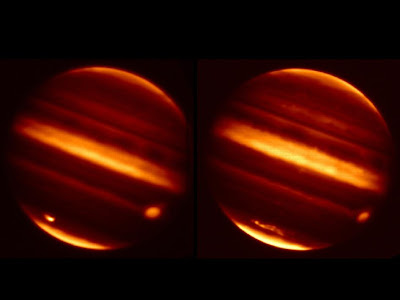
Jupiter Scar in Infrared"Both the fact that the impact itself happened at all and the implication that it may well have been an asteroid rather than a comet shows us that the outer solar system is a complex, violent and dynamic place, and that many surprises may be out there waiting for us," said Orton. "There is still a lot to sort out in the outer solar system."

The new conclusion is also consistent with evidence from results from NASA's Hubble Space Telescope indicating the impact debris in 2009 was heavier or denser than debris from comet Shoemaker-Levy 9, the last known object to hurl itself into Jupiter's atmosphere in 1994.

Before this collision, scientists had thought that the only objects that hit Jupiter were icy comets whose unstable orbits took them close enough to Jupiter to be sucked in by the giant planet's gravitational attraction. Those comets are known as Jupiter-family comets. Scientists thought Jupiter had already cleared most other objects, such as asteroids, from its sphere of influence. Besides Shoemaker-Levy, scientists know of only two other impacts in the summer of 2010, which lit up Jupiter's atmosphere.

The July 19, 2009 object likely hit Jupiter between 9 a.m. and 11 a.m. UTC. Amateur astronomer Anthony Wesley from Australia was the first to notice the scar on Jupiter, which appeared as a dark spot in visible wavelengths. The scar appeared at mid-southern latitudes. Wesley tipped off Orton and colleagues, who immediately used existing observing time at NASA's Infrared Telescope Facility in Mauna Kea, Hawaii, the following night and proposed observing time on a host of other ground-based observatories, including the Gemini North Observatory in Hawaii, the Gemini South Telescope in Chile, and the European Southern Observatory's Very Large Telescope in Chile. Data were acquired at regular intervals during the week following the 2009 collision.

The data showed that the impact had warmed Jupiter's lower stratosphere by as much as 3 to 4 Kelvin at about 42 kilometers above its cloudtops. Although 3 to 4 Kelvin does not sound like a lot, it is a significant deposition of energy because it is spread over such an enormous area.

Plunging through Jupiter's atmosphere, the object created a channel of super-heated atmospheric gases and debris. An explosion deep below the clouds – probably releasing at least around 200 trillion trillion ergs of energy, or more than 5 gigatons of TNT -- then launched debris material back along the channel, above the cloud tops, to splash back down into the atmosphere, creating the aerosol particulates and warm temperatures observed in the infrared. The blowback dredged up ammonia gas and other gases from a lower part of the atmosphere known as the troposphere into a higher part of the atmosphere known as the stratosphere.

"Comparisons between the 2009 images and the Shoemaker-Levy 9 results are beginning to show intriguing differences between the kinds of objects that hit Jupiter," Fletcher said. "The dark debris, the heated atmosphere and upwelling of ammonia were similar for this impact and Shoemaker-Levy, but the debris plume in this case didn't reach such high altitudes, didn't heat the high stratosphere, and contained signatures for hydrocarbons, silicates and silicas that weren't seen before. The presence of hydrocarbons, and the absence of carbon monoxide, provide strong evidence for a water-depleted impactor in 2009."

The detection of silica in this mixture of Jovian atmospheric gases, processed bits from the impactor and byproducts of high-energy chemical reactions was significant because abundant silica could only be produced in the impact itself, by a strong rocky body capable of penetrating very deeply into the Jovian atmosphere before exploding, but not by a much weaker comet nucleus. Assuming that the impactor had a rock-like density of around 2.5 grams per cubic centimeter (160 pounds per cubic foot), scientists calculated a likely diameter of 200 to 500 meters (700 to 1,600 feet).

Scientists computed the set of possible orbits that would bring an object into Jupiter in the right range of times and at the right locations. Then they searched the catalog of known asteroids and comets to find the kinds of objects in these orbits. An object named 2005 TS100 – which is probably an asteroid but could be an extinct comet – was one of the closest matches. Although this object was not the actual impactor, it has a very chaotic orbit and made several very close approaches to Jupiter in computer models, demonstrating that an asteroid could have hurtled into Jupiter.

"We weren't expecting to find that an asteroid was the likely culprit in this impact, but we've now learned Jupiter is getting hit by a diversity of objects," said Paul Chodas, a scientist at NASA's Near-Earth Object Program Office at JPL. " Asteroid impacts on Jupiter were thought to be quite rare compared to impacts from the so-called 'Jupiter-family comets,' but now it seems there may be a significant population of asteroids in this category."

Scientists are still working to figure out what that frequency at Jupiter is, but asteroids of this size hit Earth about once every 100,000 years. The next steps in this investigation will be to use detailed simulations of the impact to refine the size and properties of the impactor, and to continue to use imaging at infrared, as well as visible wavelengths, to search for debris from future impacts of this size or smaller.

JPL is managed for NASA by the California Institute of Technology in Pasadena.

The Two-faced Whirlpool Galaxy

NASA's Hubble Space Telescope

These images by NASA's Hubble Space Telescope show off two dramatically different face-on views of the spiral galaxy M51, dubbed the Whirlpool Galaxy.

The image at left, taken in visible light, highlights the attributes of a typical spiral galaxy, including graceful, curving arms, pink star-forming regions, and brilliant blue strands of star clusters.

In the image at right, most of the starlight has been removed, revealing the Whirlpool's skeletal dust structure, as seen in near-infrared light. This new image is the sharpest view of the dense dust in M51. The narrow lanes of dust revealed by Hubble reflect the galaxy's moniker, the Whirlpool Galaxy, as if they were swirling toward the galaxy's core.

To map the galaxy's dust structure, researchers collected the galaxy's starlight by combining images taken in visible and near-infrared light. The visible-light image captured only some of the light; the rest was obscured by dust. The near-infrared view, however, revealed more starlight because near-infrared light penetrates dust. The researchers then subtracted the total amount of starlight from both images to see the galaxy's dust structure.

The red color in the near-infrared image traces the dust, which is punctuated by hundreds of tiny clumps of stars, each about 65 light-years wide. These stars have never been seen before. The star clusters cannot be seen in visible light because dense dust enshrouds them. The image reveals details as small as 35 light-years across.

Astronomers expected to see large dust clouds, ranging from about 100 light-years to more than 300 light-years wide. Instead, most of the dust is tied up in smooth and diffuse dust lanes. An encounter with another galaxy may have prevented giant clouds from forming.

Probing a galaxy's dust structure serves as an important diagnostic tool for astronomers, providing invaluable information on how the gas and dust collapse to form stars. Although Hubble is providing incisive views of the internal structure of galaxies such as M51, the planned James Webb Space Telescope (JWST) is expected to produce even crisper images.

Researchers constructed the image by combining visible-light exposures from Jan. 18 to 22, 2005, with the Advanced Camera for Surveys (ACS), and near-infrared light pictures taken in December 2005 with the Near Infrared Camera and Multi-Object Spectrometer (NICMOS).

NASA's Hubble Finds that Puny Stars Pack a Big Punch

A deep survey of more than 200,000 stars in our Milky Way galaxy has unveiled the sometimes petulant behavior of tiny red dwarf stars. These stars, which are smaller than the Sun, can unleash powerful eruptions called flares that may release the energy of more than 100 million atomic bombs.

Red dwarfs are the most abundant stars in our universe and are presumably hosts to numerous planets. However, their erratic behavior could make life unpleasant, if not impossible, for many alien worlds. Flares are sudden eruptions of heated plasma that occur when powerful magnetic field lines in a star's atmosphere "reconnect," snapping like a rubber band and releasing vast amounts of energy. When they occur, flares would blast any planets orbiting the star with ultraviolet light, bursts of X-rays, and a gush of charged particles called a stellar wind.

artist's concept of a red dwarfStudying the light from 215,000 red dwarfs collected in observations by NASA's Hubble Space Telescope, astronomers found 100 stellar flares. The observations, taken over a seven-day period, constitute the largest continuous monitoring of red dwarf stars ever undertaken.

"We know that hyperactive young stars produce flares, but this study shows that even in fairly old stars that are several billion years old, flares are a fact of life," says astronomer Rachel Osten of the Space Telescope Science Institute in Baltimore, Md., leader of the research team. "Life could be rough for any planets orbiting close enough to these flaring stars. Their heated atmospheres could puff up and might get stripped away."

Osten and her team, including Adam Kowalski of the University of Washington in Seattle, found that the red dwarf stars flared about 15 times less frequently than in previous surveys, which observed younger and less massive stars.

The stars in this study were originally part of a search for planets. Hubble monitored the stars continuously for a week in 2006, looking for the signature of planets passing in front of them. The stars were photographed by Hubble's Advanced Camera for Surveys during the extrasolar-planet survey called the Sagittarius Window Eclipsing Extrasolar Planet Search (SWEEPS).

Osten and Kowalski realized that this powerful census contained important information on the stars themselves, and they took advantage of it. They searched the Hubble data, looking for a slight increase in the brightness of red dwarfs, a signature of flares. Some of the stars grew up to 10 percent brighter over a short period of time, which is actually much brighter than flares on our Sun. The average duration of the flares was 15 minutes. A few stars produced multiple flares.

The astronomers found that stars that periodically oscillate in brightness, called variable stars, were more prone to the short-term outbursts.

"We discovered that variable stars are about a thousand times more likely to flare than non-variable stars," Kowalski says. "The variable stars are rotating fast, which may mean they are in rapidly orbiting binary systems. If the stars possess large star spots, dark regions on a star's surface, that will cause the star's light to vary when the spots rotate in and out of view. Star spots are produced when magnetic field lines poke through the surface. So, if there are big spots, there is a large area covered by strong magnetic fields, and we found that those stars had more flares."

Although red dwarfs are smaller than the Sun, they have a deeper convection zone, where cells of hot gas bubble to the surface, like boiling oatmeal," Osten explains. This zone generates the magnetic field and enables red dwarfs to put out such energetic flares.

"The red dwarfs also have magnetic fields that are stronger than the Sun's," Osten continues. "They cover a much larger area than the Sun. Sunspots cover less than 1 percent of the Sun's surface, while red dwarfs can have star spots that cover half of their surfaces."

Kowalski will present the team's results on Jan. 10, 2011, at the American Astronomical Society meeting in Seattle, Wash.

For more information visit http://www.nasa.gov/mission_pages/hubble/science/big-punch.html

Pinwheel of Star Birth

Though the universe is chock full of spiral-shaped galaxies, no two look exactly the same. This face-on spiral galaxy, called NGC 3982, is striking for its rich tapestry of star birth, along with its winding arms. The arms are lined with pink star-forming regions of glowing hydrogen, newborn blue star clusters, and obscuring dust lanes that provide the raw material for future generations of stars. The bright nucleus is home to an older population of stars, which grow ever more densely packed toward the center.

Pinwheel of Star BirthNGC 3982 is located about 68 million light-years away in the constellation Ursa Major. The galaxy spans about 30,000 light-years, one-third of the size of our Milky Way galaxy. This color image is composed of exposures taken by the Hubble Space Telescope's Wide Field Planetary Camera 2 (WFPC2), the Advanced Camera for Surveys (ACS), and the Wide Field Camera 3 (WFC3). The observations were taken between March 2000 and August 2009. The rich color range comes from the fact that the galaxy was photographed invisible and near-infrared light. Also used was a filter that isolates hydrogen emission that emanates from bright star-forming regions dotting the spiral arms.

The Hubble Space Telescope is a project of international cooperation between NASA and the European Space Agency. NASA's Goddard Space Flight Center manages the telescope. The Space Telescope Science Institute (STScI) conducts Hubble science operations. STScI is operated for NASA by the Association of Universities for Research in Astronomy, Inc. in Washington, D.C.

For more information visit: http://www.nasa.gov/mission_pages/hubble/science/pinwheel.html

Giant Star Goes Supernova, Smothered by its Own Dust

Giant Star Goes Supernova

Astronomers using NASA's Spitzer Space Telescope have discovered that a giant star in a remote galaxy ended its life with a dust-shrouded whimper instead of the more typical bang.

Researchers suspect that this odd event -- the first one of its kind ever viewed by astronomers – was more common early in the universe.

It also hints at what we would see if the brightest star system in our Milky Way galaxy exploded, or went supernova.

The discovery is reported in a paper published online in the Astrophysical Journal. The lead author is Christopher Kochanek, a professor of astronomy at Ohio State University, Columbus.

For more information visit: http://www.nasa.gov/mission_pages/spitzer/news/spitzer20101012.html

Hubble Probes Comet 103P/Hartley 2 in Preparation for DIXI flyby

Comet 103P Hartley 2 image from hubble

Hubble Space Telescope observations of comet 103P/Hartley 2, taken on September 25, are helping in the planning for a November 4 flyby of the comet by NASA's Deep Impact eXtended Investigation (DIXI) spacecraft.

Analysis of the new Hubble data shows that the nucleus has a diameter of approximately 0.93 miles (1.5 km), which is consistent with previous estimates.

The comet is in a highly active state, as it approaches the Sun. The Hubble data show that the coma is remarkably uniform, with no evidence for the types of outgassing jets seen from most "Jupiter Family" comets, of which Hartley 2 is a member.

Jets can be produced when the dust emanates from a few specific icy regions, while most of the surface is covered with relatively inert, meteoritic-like material. In stark contrast, the activity from Hartley 2's nucleus appears to be more uniformly distributed over its entire surface, perhaps indicating a relatively "young" surface that hasn't yet been crusted over.

Hubble's spectrographs - the Cosmic Origins Spectrograph (COS) and the Space Telescope Imaging Spectrograph (STIS) -- are expected to provide unique information about the comet's chemical composition that might not be obtainable any other way, including measurements by DIXI. The Hubble team is specifically searching for emissions from carbon monoxide (CO) and diatomic sulfur (S2). These molecules have been seen in other comets but have not yet been detected in 103P/Hartley 2.

103P/Hartley has an orbital period of 6.46 years. It was discovered by Malcolm Hartley in 1986 at the Schmidt Telescope Unit in Siding Spring, Australia. The comet will pass within 11 million miles of Earth (about 45 times the distance to the Moon) on October 20. During that time the comet may be visible to the naked eye as a 5th magnitude "fuzzy star" in the constellation Auriga.

Popular Posts

Recent Posts

Sidebar Style

Powered by Blogger.

Followers

Category 5